
The Main Belt
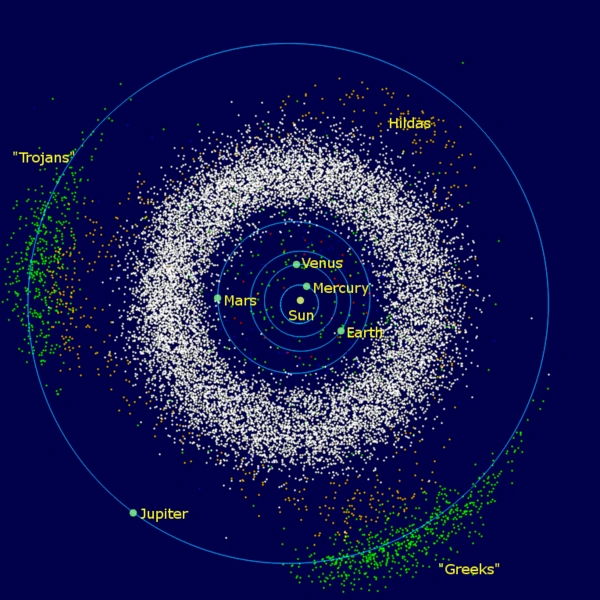
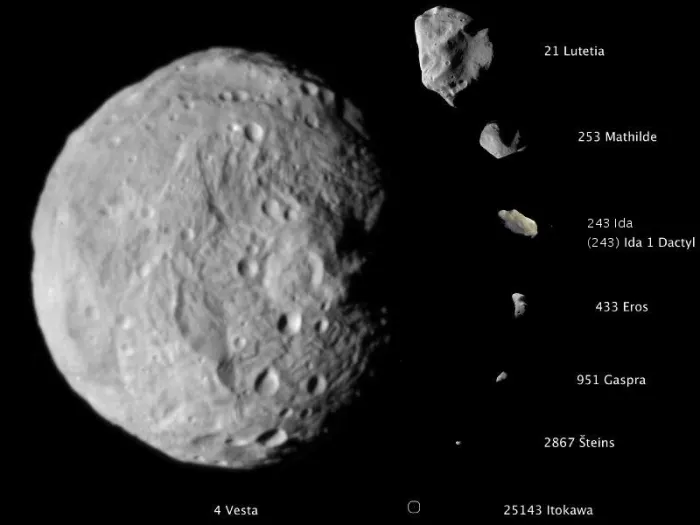
The asteroid belt, sometimes called the main belt, is situated between the orbits of Mars and Jupiter. this region is crowded with small rocky bodies called asteroids. The largest of these bodies: Ceres, Vesta, Pallas, and Hygiea have diameters larger that 400 km (248 miles). Temperatures in the asteroid belt range from 200 K (-163 F) at 2.2 astronomical units (AU) from the Sun to 165 K (- 226 F) at 3.2 AU from the Sun.
More than 200 asteroids are known to be larger than 100 km (62 miles) and over 1.5 million have diameters greater than 1 km (0.62 miles). The total mass of these objects is 4% the mass of the moon. Ceres, Vesta, Pallas, and Hygiea account for half of the asteroid belt´s mass, and Ceres, which is the largest asteroid in the belt, accounts for 1/3 of the total mass.
Different Types of Asteroids
There are three types of asteroids in the asteroid belt: C type (carbonaceous), S type (Silicate), and M type (metallic) asteroids.C type asteroids are most commonly found in the outer region of the asteroid belt, and they account for 75% of the asteroid population. S type asteroids are very common, within 2.5 AU from the Sun, in the inner region. M type asteroids are distributed at approximately 2.7 AU from the Sun, between the type C and type S populations.
At 2.7 AU from the Sun lies a region known as the snow line, where temperatures lower down below the freezing point of water. In this region planetesimals (bodies big enough to attract other bodies in space) were able to accumulate ice. Comets have been discovered beyond the snow line. A small portion of asteroids may be burned-out comets, whose ices have gone through the process of sublimation, and then blown away into space. It is believed that Earth may have acquired sufficient water to form the oceans when comets from this region were knocked out of their orbits, sending them into the Earth´s atmosphere.
The Zodiacal Light
Despite the great amount of asteroids in the main belt, they´re spread apart from one another. Spacecraft sent out into space have been able to transit through the asteroid belt without any problem. Collisions between asteroids 10 km (6.2 miles) in diameter are expected to occur once every 10 million years.
The asteroid belt contains very small particles of dust produced by collisions between asteroids. This dust in combination with the ejected material from a comet produces the zodiacal light which is the faint aurora glow extending from the direction of the Sun along the ecliptic.